
The Inner Work of Healing from Chronic Pain
The Inner Work of Healing from Chronic Pain
Explore how mindfulness and compassionate curiosity can help you navigate life’s challenges and ease the weight of stress or pain.
Explore how mindfulness and compassionate curiosity can help you navigate life’s challenges and ease the weight of stress or pain.
December 3, 2025
December 3, 2025
As a chronic pain physical therapist in Oak Park who integrates mindfulness and pain science, I’ve spent years exploring how curiosity and awareness can shift our relationship with pain. This blog is part of my ongoing effort to bring practical, compassionate tools to our community.
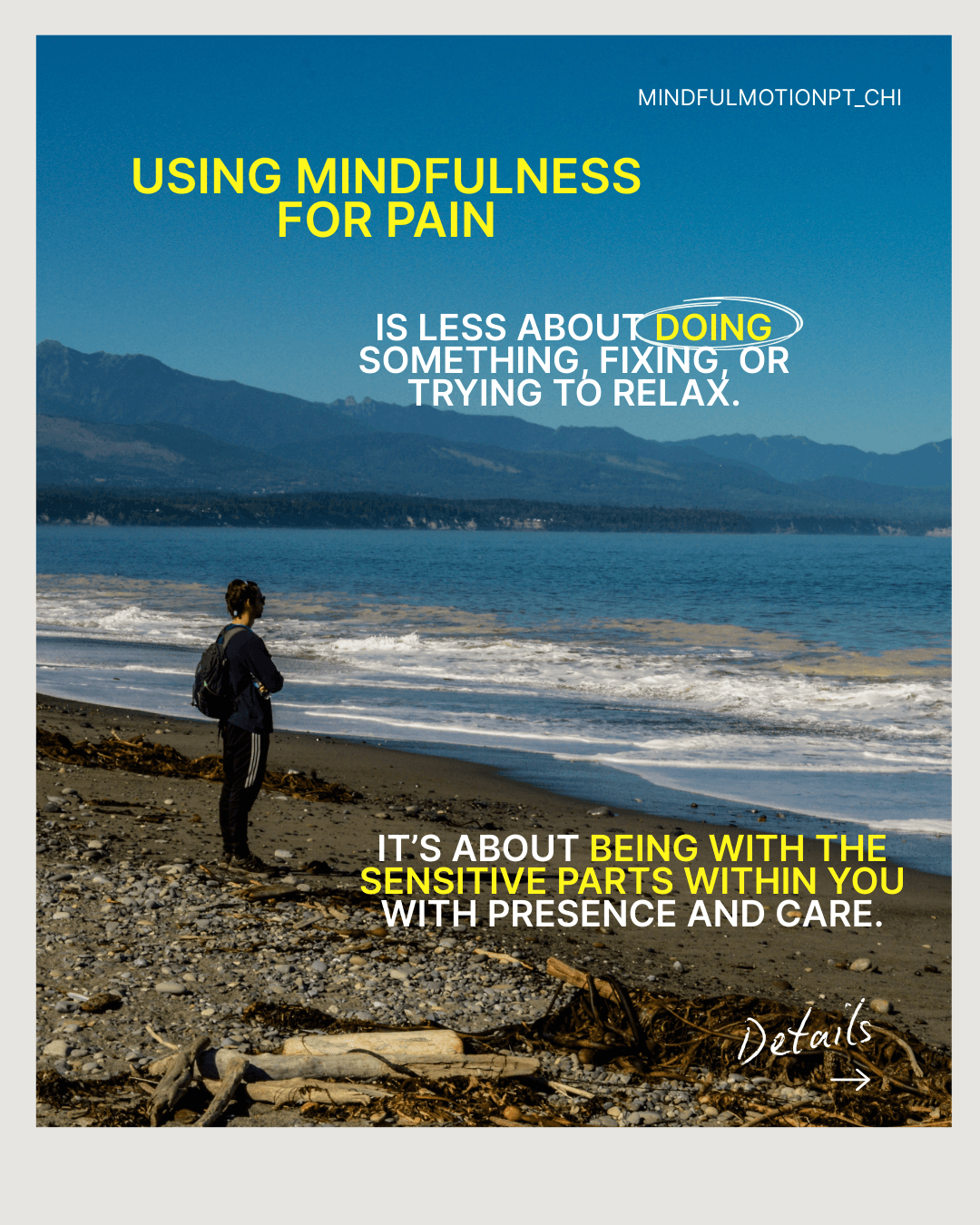
Curiosity is an interesting thing, isn’t it?
It can be looked at as a world of possibility and multiplicity.
It can lead us to many places in our minds and in our lives that we didn’t expect.
It can lead us into a trinket store on vacation where we buy a whale mug which, when we see it years later, brings us back to the winding roads and rolling hills of Northern California.
Curiosity leads us down paths that we didn’t know existed, and wouldn’t have discovered at all, if we hadn’t taken the time to ponder them.
Curiosity isn’t just limited to questions like, “What am I going to have for dinner?”
Open curiosity can bring us layers deeper into our experience of being human, into questions like:
“What’s it like to be me?”
“How do my automatic and habitual patterns influence my moment-by-moment experience?”
“How might intentional awareness and kind curiosity toward these habit patterns improve my lived experience and those around me?”
“What might I learn about myself if I slowed down enough to listen?”
For those living with chronic illness or chronic pain, many of whom I work with in my physical therapy practice here in Oak Park, these questions can be especially important. They can also get more specific while still maintaining openness and kindness toward whatever answers arise. This often leads to a deeper source of healing that is right beneath the surface. And if we have the clarity, focused loving-awareness, and non-judgmental attention, we can truly listen, hear, and abide.
This is where mindfulness often leads us, if we continue following its path.

The Pull of Distraction in Modern Life
To do this, we need to start at the beginning.
Most of us are drowning in information and stimulation in the fast-moving world we live in. I personally struggle with consistently checking work emails, the allure of bingeing TV shows nightly, and the pull and delights of the rectangular portal in my pocket (read: phone)—to name just a few. These weights pull me further into the abyss—further away from this moment, this breath, and this breath, and this breath. You get the point.
The immediacy and frictionless access to infinite entertainment is not something we’ve evolved to fully cope with—unless we take intentional action to change our habits. For those interested, Neil Postman’s 1985 book Amusing Ourselves to Death feels especially pertinent nowadays.
Now, I’m not here to yuck anyone’s yum, I’m not intending to come across as holier-than-thou, and I hope this doesn’t land that way. The point I’m trying to make is that with entertainment so constantly and readily available, it’s incredibly easy to overlook, or be blissfully unaware of, our internal world and the impact it has on our normal waking consciousness. This is especially true for my clients with chronic pain in Oak Park and the greater Chicago area.

An Alternative Path: The Internal Refuge
So what’s the alternative?
The practice I’ve been working with personally and professionally for the past five years can be summed up in one, possibly run-on sentence:
By developing an internal refuge of non-judgmental, kind, and patient awareness, driven by a gentle, observer-like curiosity toward anything that arises in our consciousness.
That’s a dense sentence, and one I plan to continue exploring in future posts. But for the purposes of the rest of this blog, I’d like to lay out the general framework of how this might be done and its impact on those living with chronic pain.
Beginning with the Breath
In mindfulness, we begin with the breath as a way to focus our scattered minds and develop this quality of non-judgmental, kind, and patient attention. This is typically done via stillness meditations in which we focus on the breath; however, there are many pathways to the same end, including moving meditations (standing, walking, seated), Metta meditation, body-based meditations, and more.
The quality of attention is crucial, because it allows that which resides outside our awareness (read: subconscious) to bubble to the surface and be seen.
One little quip here—if you’re curious to try it, I’ll be linking to a short guided meditation from my YouTube channel that pairs nicely with this section. Sometimes hearing the guidance can make all the difference.

Meeting What Arises with Compassion
To see, hear, and be with whatever arises—emotions, memories, deeply held beliefs—in a different way than we usually do (with fear, retraction, avoidance) helps us grow our capacity to be with the difficult parts of ourselves that actually need something altogether different (love, care, comfort, etc.).
As we begin recognizing what’s present and allowing it to be there, we can then investigate what arises in a compassionate way. I often describe this step as if you’re a parent checking in with a child who came inside with a scraped knee and is crying. We might begin asking questions to the emotions or parts of us that arise, in a kind and patient way:
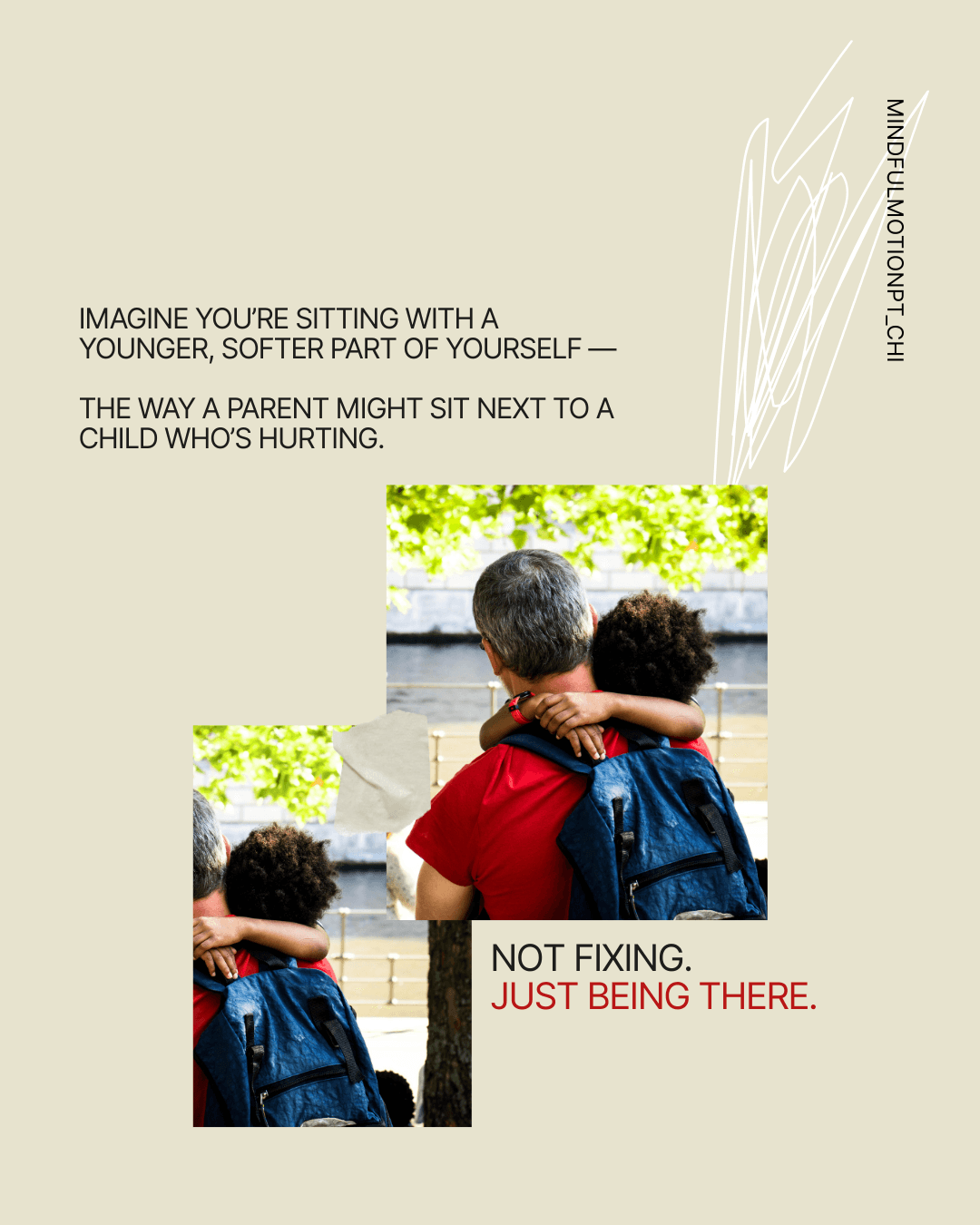
“What happened to you?”
“What do you need from me?”
“What do you need to feel seen, heard, or safe?”
“Can I just be with this?”
This step of compassionate inquiry is often the missing link in mindfulness. At its root, mindfulness is a relationship-changing activity and a way of being in the world that allows every part of us to be expressed. The effects of this can be profound and are a central part of the healing process for individuals with and without chronic pain.
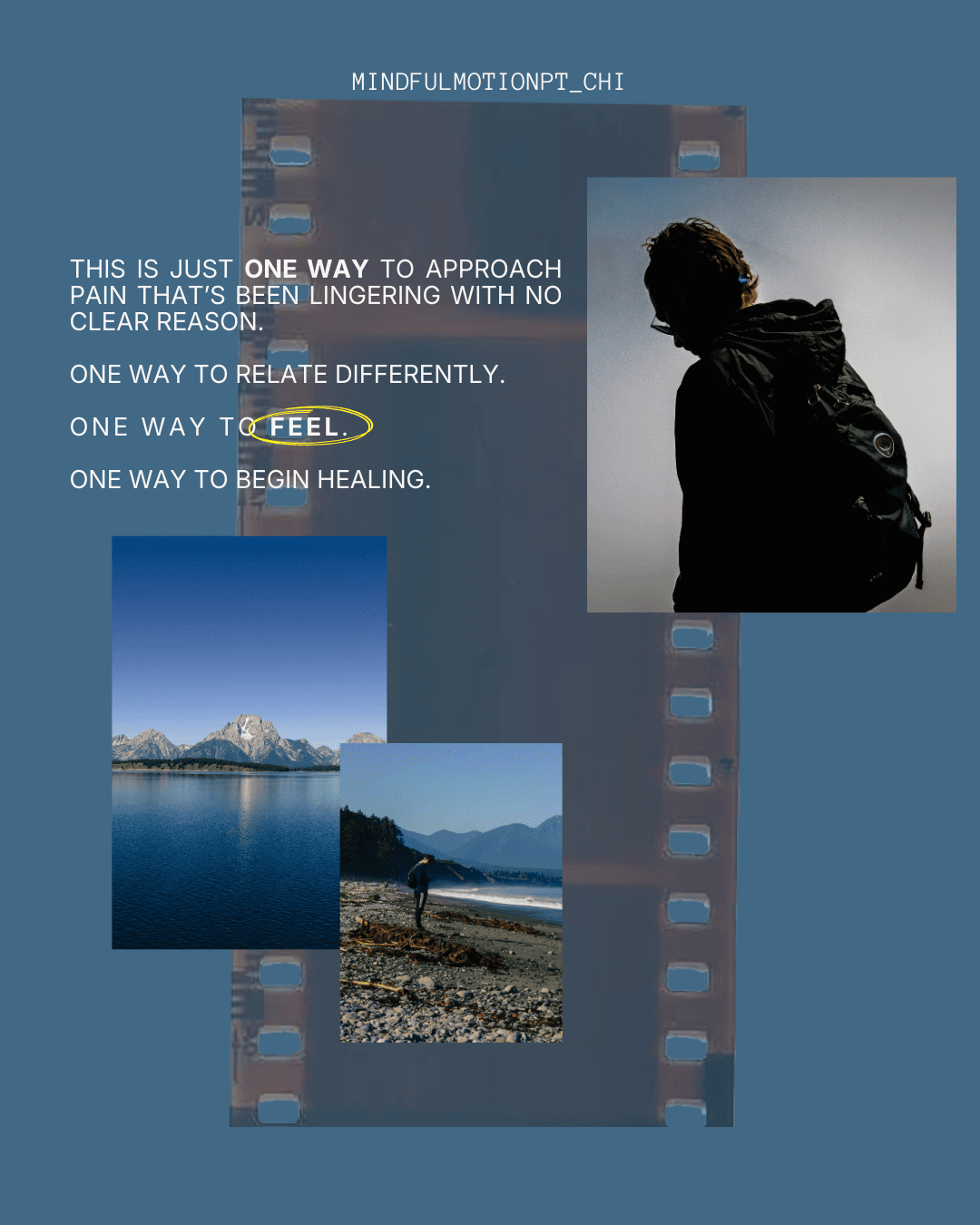
The Return: Nurturing Awareness
It is a delicate process that requires patience, care, and understanding, because what arises will likely be hurting. Knowing how to ground oneself in the breath when difficult emotions arise provides the refuge we can always return to.
After this inquiry comes the time to simply be with whatever remains in a warm and compassionate way. It’s time to nurture.
As Tara Brach popularized in the RAIN framework—Recognize, Allow, Investigate, Nurture—this is an ongoing process that requires time. Yet it is a worthwhile one nonetheless.
If You’d Like to Explore This More
If this form of mindfulness and compassionate inquiry seems like something you might connect with or want to explore, please reach out.
If you would like to explore how mindfulness fits into a physical therapy plan of care, especially for chronic pain, I would love to talk more. Mindful Motion Physical Therapy here in Oak Park was built around this integrative approach.
If you want to learn more about this way of approaching emotions and pain then check out my previous blogs on how to meditate with pain and how to reframe chronic pain.
If you simply need advice about where to find more information, again, please reach out.
If you’re searching for chronic pain physical therapy in Oak Park that blends mindfulness, movement, and compassion then you’re in the right place.
In the meantime, keep going.
—Chris
As a chronic pain physical therapist in Oak Park who integrates mindfulness and pain science, I’ve spent years exploring how curiosity and awareness can shift our relationship with pain. This blog is part of my ongoing effort to bring practical, compassionate tools to our community.
Curiosity is an interesting thing, isn’t it?
It can be looked at as a world of possibility and multiplicity.
It can lead us to many places in our minds and in our lives that we didn’t expect.
It can lead us into a trinket store on vacation where we buy a whale mug which, when we see it years later, brings us back to the winding roads and rolling hills of Northern California.
Curiosity leads us down paths that we didn’t know existed, and wouldn’t have discovered at all, if we hadn’t taken the time to ponder them.
Curiosity isn’t just limited to questions like, “What am I going to have for dinner?”
Open curiosity can bring us layers deeper into our experience of being human, into questions like:
“What’s it like to be me?”
“How do my automatic and habitual patterns influence my moment-by-moment experience?”
“How might intentional awareness and kind curiosity toward these habit patterns improve my lived experience and those around me?”
“What might I learn about myself if I slowed down enough to listen?”
For those living with chronic illness or chronic pain, many of whom I work with in my physical therapy practice here in Oak Park, these questions can be especially important. They can also get more specific while still maintaining openness and kindness toward whatever answers arise. This often leads to a deeper source of healing that is right beneath the surface. And if we have the clarity, focused loving-awareness, and non-judgmental attention, we can truly listen, hear, and abide.
This is where mindfulness often leads us, if we continue following its path.
The Pull of Distraction in Modern Life
To do this, we need to start at the beginning.
Most of us are drowning in information and stimulation in the fast-moving world we live in. I personally struggle with consistently checking work emails, the allure of bingeing TV shows nightly, and the pull and delights of the rectangular portal in my pocket (read: phone)—to name just a few. These weights pull me further into the abyss—further away from this moment, this breath, and this breath, and this breath. You get the point.
The immediacy and frictionless access to infinite entertainment is not something we’ve evolved to fully cope with—unless we take intentional action to change our habits. For those interested, Neil Postman’s 1985 book Amusing Ourselves to Death feels especially pertinent nowadays.
Now, I’m not here to yuck anyone’s yum, I’m not intending to come across as holier-than-thou, and I hope this doesn’t land that way. The point I’m trying to make is that with entertainment so constantly and readily available, it’s incredibly easy to overlook, or be blissfully unaware of, our internal world and the impact it has on our normal waking consciousness. This is especially true for my clients with chronic pain in Oak Park and the greater Chicago area.
An Alternative Path: The Internal Refuge
So what’s the alternative?
The practice I’ve been working with personally and professionally for the past five years can be summed up in one, possibly run-on sentence:
By developing an internal refuge of non-judgmental, kind, and patient awareness, driven by a gentle, observer-like curiosity toward anything that arises in our consciousness.
That’s a dense sentence, and one I plan to continue exploring in future posts. But for the purposes of the rest of this blog, I’d like to lay out the general framework of how this might be done and its impact on those living with chronic pain.
Beginning with the Breath
In mindfulness, we begin with the breath as a way to focus our scattered minds and develop this quality of non-judgmental, kind, and patient attention. This is typically done via stillness meditations in which we focus on the breath; however, there are many pathways to the same end, including moving meditations (standing, walking, seated), Metta meditation, body-based meditations, and more.
The quality of attention is crucial, because it allows that which resides outside our awareness (read: subconscious) to bubble to the surface and be seen.
One little quip here—if you’re curious to try it, I’ll be linking to a short guided meditation from my YouTube channel that pairs nicely with this section. Sometimes hearing the guidance can make all the difference.
Meeting What Arises with Compassion
To see, hear, and be with whatever arises—emotions, memories, deeply held beliefs—in a different way than we usually do (with fear, retraction, avoidance) helps us grow our capacity to be with the difficult parts of ourselves that actually need something altogether different (love, care, comfort, etc.).
As we begin recognizing what’s present and allowing it to be there, we can then investigate what arises in a compassionate way. I often describe this step as if you’re a parent checking in with a child who came inside with a scraped knee and is crying. We might begin asking questions to the emotions or parts of us that arise, in a kind and patient way:
“What happened to you?”
“What do you need from me?”
“What do you need to feel seen, heard, or safe?”
“Can I just be with this?”
This step of compassionate inquiry is often the missing link in mindfulness. At its root, mindfulness is a relationship-changing activity and a way of being in the world that allows every part of us to be expressed. The effects of this can be profound and are a central part of the healing process for individuals with and without chronic pain.
The Return: Nurturing Awareness
It is a delicate process that requires patience, care, and understanding, because what arises will likely be hurting. Knowing how to ground oneself in the breath when difficult emotions arise provides the refuge we can always return to.
After this inquiry comes the time to simply be with whatever remains in a warm and compassionate way. It’s time to nurture.
As Tara Brach popularized in the RAIN framework—Recognize, Allow, Investigate, Nurture—this is an ongoing process that requires time. Yet it is a worthwhile one nonetheless.
If You’d Like to Explore This More
If this form of mindfulness and compassionate inquiry seems like something you might connect with or want to explore, please reach out.
If you would like to explore how mindfulness fits into a physical therapy plan of care, especially for chronic pain, I would love to talk more. Mindful Motion Physical Therapy here in Oak Park was built around this integrative approach.
If you want to learn more about this way of approaching emotions and pain then check out my previous blogs on how to meditate with pain and how to reframe chronic pain.
If you simply need advice about where to find more information, again, please reach out.
If you’re searching for chronic pain physical therapy in Oak Park that blends mindfulness, movement, and compassion then you’re in the right place.
In the meantime, keep going.
—Chris
Chris Voirin
Chris Voirin
our journal
our journal
More insights for you.
More insights for you.
Explore more reflections, guidance, and practical tools to support your growth and well-being.
Explore more reflections, guidance, and practical tools to support your growth and well-being.

Pain can change when the nervous system reinterprets threat. Threat reappraisal explains how.
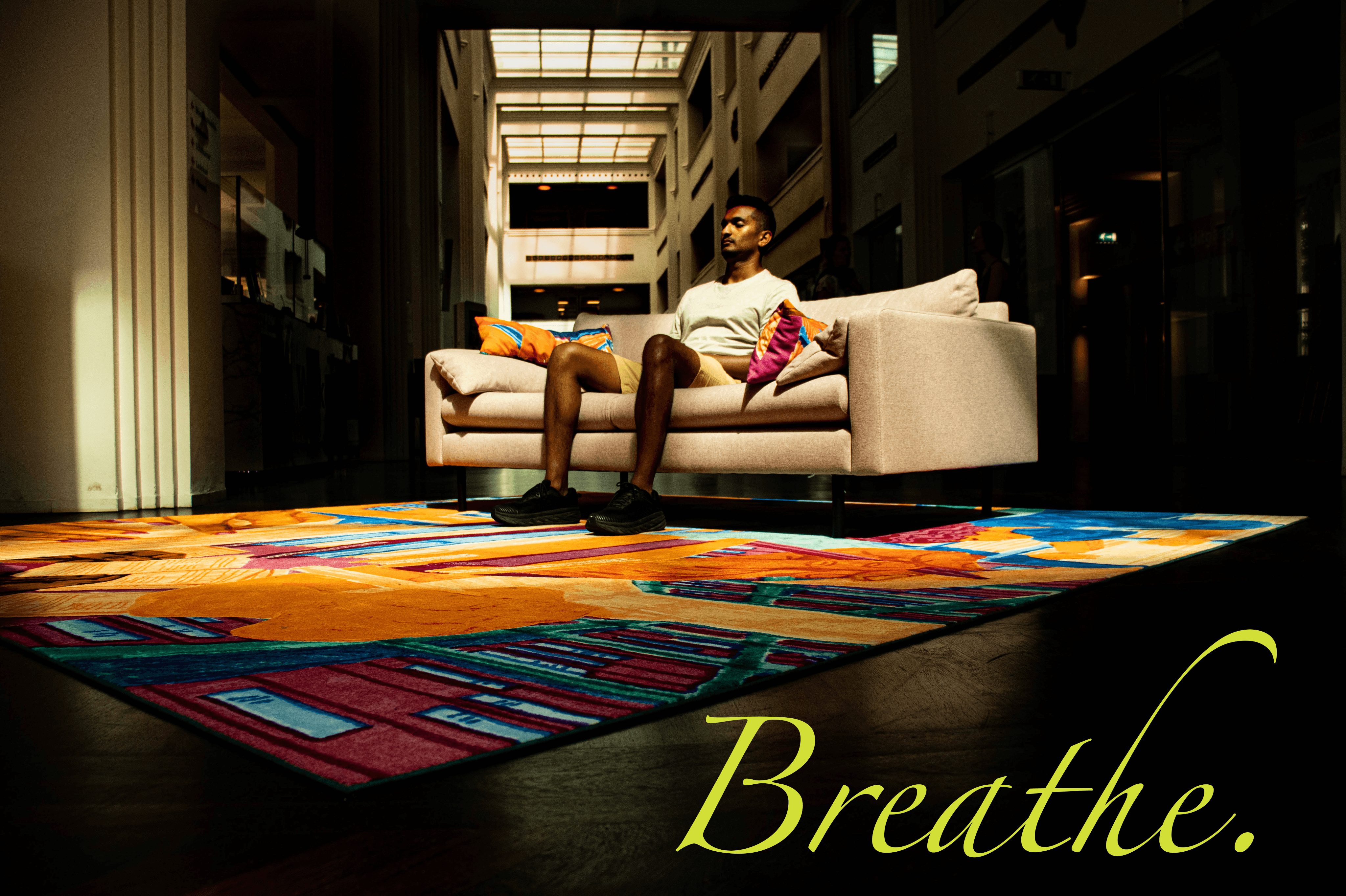
Experience a guided meditation focused on easing pain and discomfort.
Experience a guided meditation focused on easing pain and discomfort.
Your questions.
Answered.
Not sure what to expect? These answers might help you feel more confident as you begin.
Didn’t find your answer? Send us a message — we’ll respond with care and clarity.
How is this different than other physical therapy practices?
We don’t just chase symptoms, we help you understand them and find the root cause. Most PT clinics will give you a list of exercises, send you home, and hope for the best. At Mindful Motion, we slow things down. We start by listening to your story, digging into the “why” behind your pain, and creating a plan that works for your life.
How is this different than other physical therapy practices?
We don’t just chase symptoms, we help you understand them and find the root cause. Most PT clinics will give you a list of exercises, send you home, and hope for the best. At Mindful Motion, we slow things down. We start by listening to your story, digging into the “why” behind your pain, and creating a plan that works for your life.
What can I expect from the first session?
What can I expect from the first session?
The first session is all about getting a thorough background, comprehensive analysis of your strength, flexibility, and mobility, and understanding your history with pain. You’ll talk with your PT about what brings you here, what's held you back in the past, and where you'd like to go.
Do you offer both online and in-person sessions?
Do you offer both online and in-person sessions?
Yes. Whether you prefer meeting face-to-face or from the comfort of home, we offer flexible options to meet you where you are.
What treatment strategies do you employ?
What treatment strategies do you employ?
Some of the skills which we will discuss and develop are listed below.
Graded and meaningful progression into safe movement and exercise based on your initial evaluation.
Education on Pain Neuroscience and how our understanding of pain and our nervous system plays a large role in our experience of pain.
Developing Mindfulness Meditation skills as a tool to calm the nervous system, relate to your pain differently, create a deeper understanding of your thoughts, emotions, and sensations to provide a fuller experience of daily life and deepen your presence.
Identifying and developing a plan surrounding your personal values which you would like to lead life by.
Other things which we will address are adequate sleep hygiene, appropriate aerobic exercise, working with acceptance of what is, and much more.
Why Mindfulness Meditation?
Why Mindfulness Meditation?
Depending on where you want to go in your therapy, Mindfulness Meditation can act as any number of things for you and your life. Let's start with some definitions.
Mindfulness is the purposeful ability to observe one's thoughts, feelings, and physical sensations without judgment, and to be fully present in the current moment
Meditation is the tool which we use to cultivate mindfulness in our daily lives.
Okay... so why mindfulness meditation for my recovery?
The implications of practicing Mindfulness Meditation with patience and persistence can be profound to your recovery from injury or pain. It can also have an impact to your contact to the present moment, your relationships to yourself and your thoughts, to your loved ones, and the world. You can learn to deal with stress, hardships, and the ups and downs of life with more equanimity.
We're taking your body to the gym by doing the exercises we prescribe. Why not also take your mind to the gym and help create lasting habits which can improve your quality of life?
Your questions.
Answered.
Not sure what to expect? These answers might help you feel more confident as you begin.
How is this different than other physical therapy practices?
We don’t just chase symptoms, we help you understand them and find the root cause. Most PT clinics will give you a list of exercises, send you home, and hope for the best. At Mindful Motion, we slow things down. We start by listening to your story, digging into the “why” behind your pain, and creating a plan that works for your life.
How is this different than other physical therapy practices?
We don’t just chase symptoms, we help you understand them and find the root cause. Most PT clinics will give you a list of exercises, send you home, and hope for the best. At Mindful Motion, we slow things down. We start by listening to your story, digging into the “why” behind your pain, and creating a plan that works for your life.
What can I expect from the first session?
What can I expect from the first session?
The first session is all about getting a thorough background, comprehensive analysis of your strength, flexibility, and mobility, and understanding your history with pain. You’ll talk with your PT about what brings you here, what's held you back in the past, and where you'd like to go.
Do you offer both online and in-person sessions?
Do you offer both online and in-person sessions?
Yes. Whether you prefer meeting face-to-face or from the comfort of home, we offer flexible options to meet you where you are.
What treatment strategies do you employ?
What treatment strategies do you employ?
Some of the skills which we will discuss and develop are listed below.
Graded and meaningful progression into safe movement and exercise based on your initial evaluation.
Education on Pain Neuroscience and how our understanding of pain and our nervous system plays a large role in our experience of pain.
Developing Mindfulness Meditation skills as a tool to calm the nervous system, relate to your pain differently, create a deeper understanding of your thoughts, emotions, and sensations to provide a fuller experience of daily life and deepen your presence.
Identifying and developing a plan surrounding your personal values which you would like to lead life by.
Other things which we will address are adequate sleep hygiene, appropriate aerobic exercise, working with acceptance of what is, and much more.
Why Mindfulness Meditation?
Why Mindfulness Meditation?
Depending on where you want to go in your therapy, Mindfulness Meditation can act as any number of things for you and your life. Let's start with some definitions.
Mindfulness is the purposeful ability to observe one's thoughts, feelings, and physical sensations without judgment, and to be fully present in the current moment
Meditation is the tool which we use to cultivate mindfulness in our daily lives.
Okay... so why mindfulness meditation for my recovery?
The implications of practicing Mindfulness Meditation with patience and persistence can be profound to your recovery from injury or pain. It can also have an impact to your contact to the present moment, your relationships to yourself and your thoughts, to your loved ones, and the world. You can learn to deal with stress, hardships, and the ups and downs of life with more equanimity.
We're taking your body to the gym by doing the exercises we prescribe. Why not also take your mind to the gym and help create lasting habits which can improve your quality of life?
Didn’t find your answer? Send us a message — we’ll respond with care and clarity.
Your questions.
Answered.
Not sure what to expect? These answers might help you feel more confident as you begin.
Didn’t find your answer? Send us a message — we’ll respond with care and clarity.
How is this different than other physical therapy practices?
We don’t just chase symptoms, we help you understand them and find the root cause. Most PT clinics will give you a list of exercises, send you home, and hope for the best. At Mindful Motion, we slow things down. We start by listening to your story, digging into the “why” behind your pain, and creating a plan that works for your life.
How is this different than other physical therapy practices?
We don’t just chase symptoms, we help you understand them and find the root cause. Most PT clinics will give you a list of exercises, send you home, and hope for the best. At Mindful Motion, we slow things down. We start by listening to your story, digging into the “why” behind your pain, and creating a plan that works for your life.
What can I expect from the first session?
What can I expect from the first session?
The first session is all about getting a thorough background, comprehensive analysis of your strength, flexibility, and mobility, and understanding your history with pain. You’ll talk with your PT about what brings you here, what's held you back in the past, and where you'd like to go.
Do you offer both online and in-person sessions?
Do you offer both online and in-person sessions?
Yes. Whether you prefer meeting face-to-face or from the comfort of home, we offer flexible options to meet you where you are.
What treatment strategies do you employ?
What treatment strategies do you employ?
Some of the skills which we will discuss and develop are listed below.
Graded and meaningful progression into safe movement and exercise based on your initial evaluation.
Education on Pain Neuroscience and how our understanding of pain and our nervous system plays a large role in our experience of pain.
Developing Mindfulness Meditation skills as a tool to calm the nervous system, relate to your pain differently, create a deeper understanding of your thoughts, emotions, and sensations to provide a fuller experience of daily life and deepen your presence.
Identifying and developing a plan surrounding your personal values which you would like to lead life by.
Other things which we will address are adequate sleep hygiene, appropriate aerobic exercise, working with acceptance of what is, and much more.
Why Mindfulness Meditation?
Why Mindfulness Meditation?
Depending on where you want to go in your therapy, Mindfulness Meditation can act as any number of things for you and your life. Let's start with some definitions.
Mindfulness is the purposeful ability to observe one's thoughts, feelings, and physical sensations without judgment, and to be fully present in the current moment
Meditation is the tool which we use to cultivate mindfulness in our daily lives.
Okay... so why mindfulness meditation for my recovery?
The implications of practicing Mindfulness Meditation with patience and persistence can be profound to your recovery from injury or pain. It can also have an impact to your contact to the present moment, your relationships to yourself and your thoughts, to your loved ones, and the world. You can learn to deal with stress, hardships, and the ups and downs of life with more equanimity.
We're taking your body to the gym by doing the exercises we prescribe. Why not also take your mind to the gym and help create lasting habits which can improve your quality of life?